
Jun 26, 2026Buying Guide
How to Choose Office Chairs for Long Working Hours (Bulk Buying): A Practical Guide for Distributors & Procurement Teams
Learn what specs actually matter for long work days: lumbar support design, molded foam, adjustable fit range, synchronized tilt, gaslift class, and caster durability—plus a benchmark spec example.

If you sell office chairs in bulk, you’ve probably seen this story:
The chair looks “ergonomic” in a catalog, feels okay on day one… and then three months later, your client calls: “The seat feels flat,” “My team’s back hurts,” “Wheels are breaking,” “Can we return these?”
So let’s skip the marketing words. When people sit 8+ hours a day, an office chair isn’t decoration — it’s a daily tool that affects posture, comfort, and how often you get complaints.
Here’s the simple rule: buy specs, not slogans.
1) Ergonomic Support: Backrest & Breathable Mesh for Long-Hour Seating
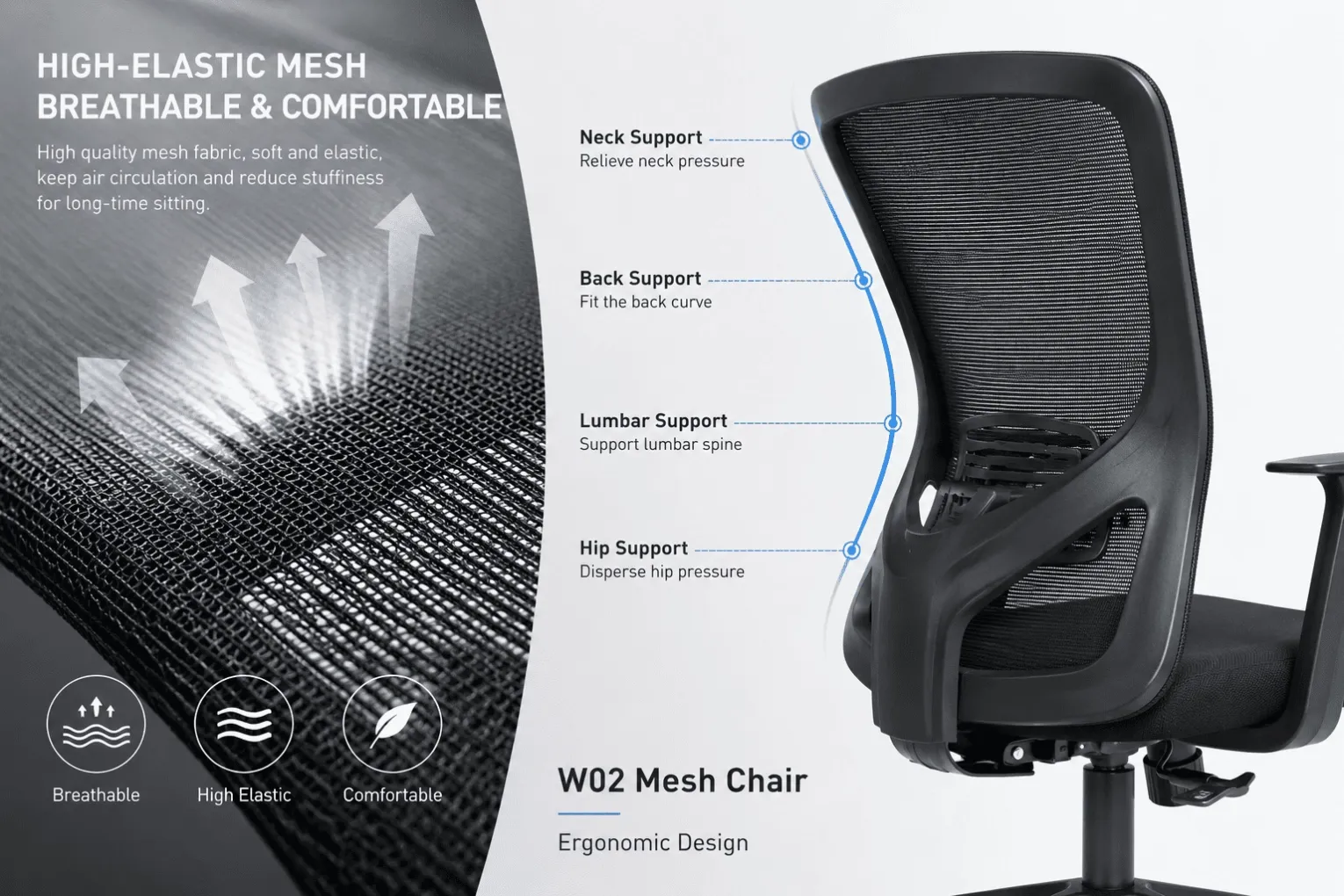
The first thing that fails on a long work day is posture. People don’t sit like a textbook all day. They get tired, they slide forward, they slump.
So when you’re checking a chair, don’t ask “Is it ergonomic?”
Ask: Does the lumbar support keep working when the user gets tired?
What I look for (simple)
- Separate lumbar + backrest structure (better than one-piece shell) Why: lumbar support stays “active” and doesn’t disappear when someone shifts around.
- Breathable mesh backrest Heat is a real productivity killer. A breathable mesh back helps keep people comfortable for long work days.
- Mesh quality hint “Mesh” can mean anything. You want something like high-tension nylon mesh that won’t sag quickly. “When I review chairs for long-hour use, I don’t care how many times the listing says ‘ergonomic.’ I check if lumbar support still feels ‘there’ after users start slouching.”
2) Foam Density Standards for Heavy-Duty Office Chairs
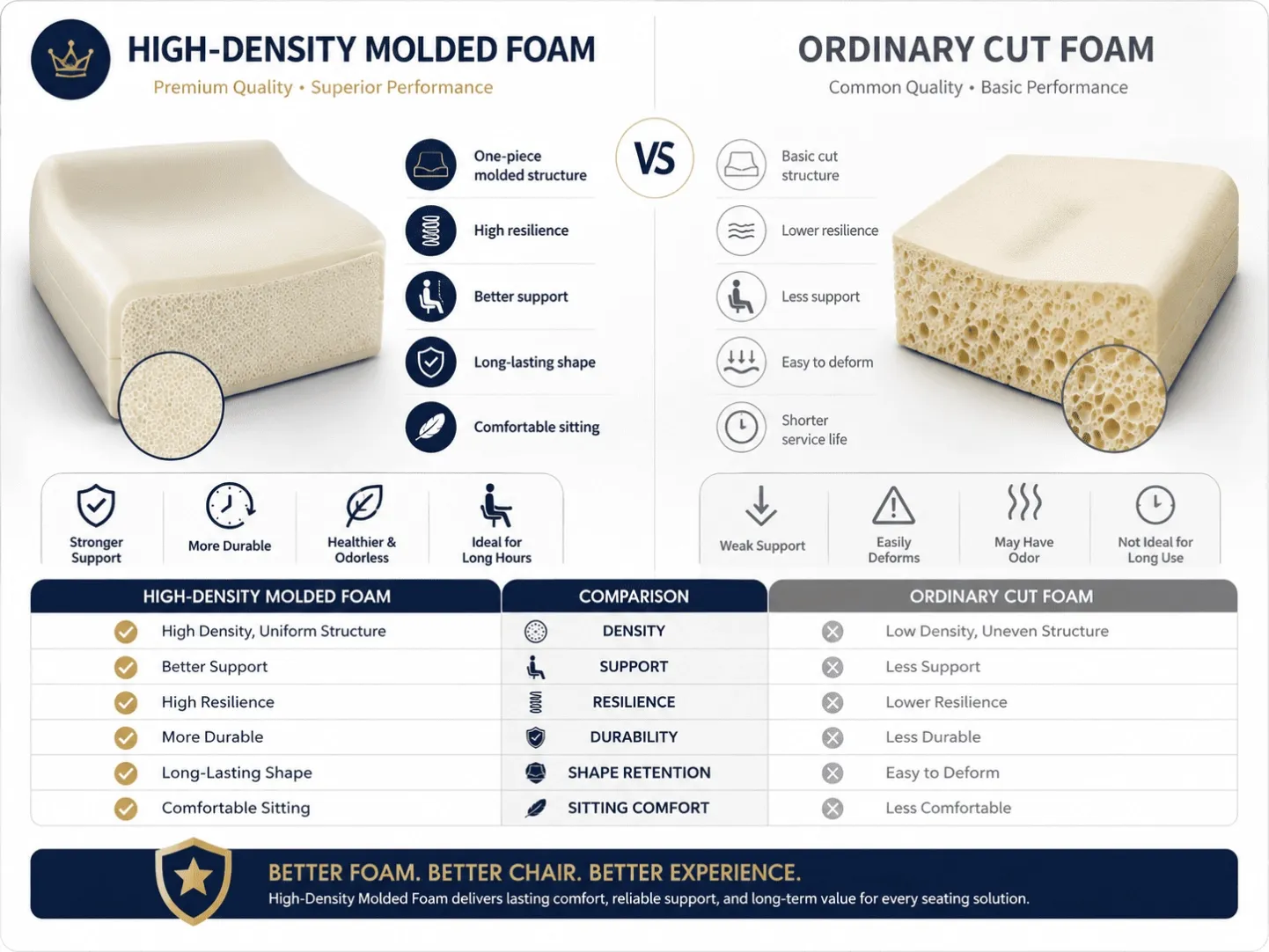
If your buyers complain “It was comfortable at first, now it feels hard,” it’s usually the foam.
The common problem
A lot of chairs use basic “cut foam.” It flattens faster, especially in commercial use.
The safer spec for long hours
For 4+ hours/day usage, I’d treat molded foam as the baseline (often 50-density molded foam or higher).
Why molded foam matters :
- it rebounds better
- it holds its shape longer
- it keeps comfort more consistent over time
Distributor-friendly phrasing:
“Molded foam isn’t a luxury feature. It’s how you avoid the ‘six-month flattening’ complaint.”
3) Fit coverage: adjustability reduces complaints and returns
In bulk buying, you’re not fitting one person. You’re fitting a whole team. That’s why adjustability is basically risk control.
Non-negotiable
- Adjustable seat height If people can’t put feet flat and sit stable, posture breaks immediately.
“Nice-to-have but actually useful”
- Adjustable headrest (static headrests can create misfit) Look for something like nylon + fiberglass with ~6 cm vertical adjustment.
- 2D adjustable armrests with PU top This is huge for typing-heavy roles. It helps shoulders relax and reduces elbow pressure.
“In shared offices, the fastest way to create complaints is a chair that only fits one body type.”
4) Mechanism: long hours need movement (not just rocking)
People aren’t meant to sit frozen. Good chairs help users move a little without losing support.
What to avoid
Basic “rocking” where feet lift off the floor. It feels unstable and gets annoying fast.
What to ask for
- Synchronized tilt (back + seat moving together in a controlled ratio)
- Lock positions (like a 3-position lock) so users can switch between upright focus and relaxed recline
- Stable swivel base (reduces awkward twisting at busy workstations)
5) Durability & TCO: Wholesale Seating Specs That Protect Your Margins
TCO is simple: if a caster breaks or a gas lift fails, the whole chair becomes a problem.
Two specs I always verify
- Gas lift: Class 3 (or higher)
- Casters: ask for test proof Example: “100,000-cycle durability test” is the kind of language that helps procurement feel safe.
This is where wholesalers win:
When you can show durability evidence, you’re not forced into price wars.
Reference Spec Example (Benchmark): Model 186A
Use this as a benchmark profile when comparing chairs for long-hour workstations:
- BIFMA-aligned compliance target
- Separate lumbar/back structure + breathable nylon mesh
- Headrest: nylon + fiberglass, ~6 cm adjustable range
- Armrests: 2D adjustable with PU top
- Seat: 50-density molded foam
- Mechanism: synchronized tilt with 3-position lock
- Gas lift: Class 3
- Casters: reinforced PU wheels with 100,000-cycle durability evidence
Here’s a benchmark spec profile we use when building a long-hour workstation lineup.
Quick Summary (for skim readers)
If you’re buying for long work days in bulk, check these first:
- Lumbar support structure (separate lumbar works better)
- Breathable mesh (heat matters)
- Molded foam seat (comfort consistency)
- Adjustable seat height (fit coverage)
- Synchronized tilt + lock (movement without losing support)
- Class 3 gas lift + caster durability proof (protect TCO)
FAQ
Q1: Is “ergonomic” enough for procurement?
No. Ask what’s behind the label: lumbar design, foam type, mechanism, and durability proof.
Q2: Why do chairs feel worse after a few months?
Usually foam flattening, weak mechanisms, or low-grade casters — not “people sitting wrong.”
Q3: Is breathable mesh always better?
Not always, but for long work days, breathable mesh helps with heat and comfort consistency.
Q4: What’s the #1 adjustability feature?
Adjustable seat height. If that’s wrong, posture fails immediately.
Q5: What specs protect TCO the most?
Gas lift class (Class 3+) and caster durability evidence.
About the Author: Written by Jony, a commercial furniture sourcing expert with 15 years of manufacturing experience in premium office seating and ergonomic workstations.